Why do highly capable professionals sometimes struggle to turn their expertise into commercial growth? Explore what beliefs shape commercial behaviour and how organisations can unlock greater impact by looking beyond traditional sales skills.

Some of the most capable professionals struggle to translate their expertise into commercial growth
Professional services firms are full of people who are trusted by clients, technically excellent and deeply knowledgeable about their field. Yet as they become more senior, the expectation changes. They are increasingly required not only to deliver excellent work, but to originate it: identifying opportunities, deepening client relationships, influencing decisions and contributing to growth.
And organisations find themselves asking a familiar question:
“Our people are brilliant at what they do, but why aren’t they more commercial?”
It is tempting to assume the answer is straightforward. Perhaps they need more confidence. Better sales skills. A clearer methodology. Sometimes they do. But there may be something more fundamental happening.
The problem with “selling” / reframing what it means to sell
For many professionals, sales doesn’t sit naturally alongside how they see themselves.
Their credibility has been built around expertise, objectivity and trusted advice. Selling, by contrast, can still conjure a very different stereotype: pushy, transactional, overly persuasive or focused more on securing the deal than creating value.
Effective selling in professional services isn’t always about delivering the perfect pitch.
It often looks much more like excellent client work: understanding what a client really needs, recognising where expertise can create additional value, initiating a conversation rather than waiting to be asked, challenging thinking appropriately and helping clients make better decisions.
Seen this way, commercial effectiveness becomes much closer to the capabilities professionals already value.
The objective is not to turn trusted advisers into stereotypical salespeople. It is to help them apply their expertise, judgement and relationships more deliberately to recognising opportunities and creating value.
What sits beneath commercial behaviour?
That reframing matters because how people think about selling can shape how they behave commercially.
If commercial activity feels inconsistent with professional credibility, someone may hesitate to raise an opportunity they can clearly see. They may avoid challenging a client because they worry about damaging the relationship. They may wait for permission to enter a commercial conversation rather than initiating one themselves.
The issue is not necessarily that they do not know what to do. It may be the belief system shaping how they interpret the situation in the first place.
That distinction becomes important when we consider why professionals with similar experience and technical capability can respond so differently to the same opportunity.
One may recognise the opportunity and act. Another may hesitate. One may remain engaged when progress becomes difficult, while another begins to step away.
Describing one person as simply “more commercial” tells us very little about why. And if we do not understand the cause, it becomes difficult to know what development will actually make a difference.
Moving beyond the label of “commercial”
This is where a more diagnostic view of commercial capability becomes useful.
Our research into approximately 50,000 commercial professionals explored the belief patterns associated with stronger commercial effectiveness and compared the highest-performing 5% with lower-performing groups.
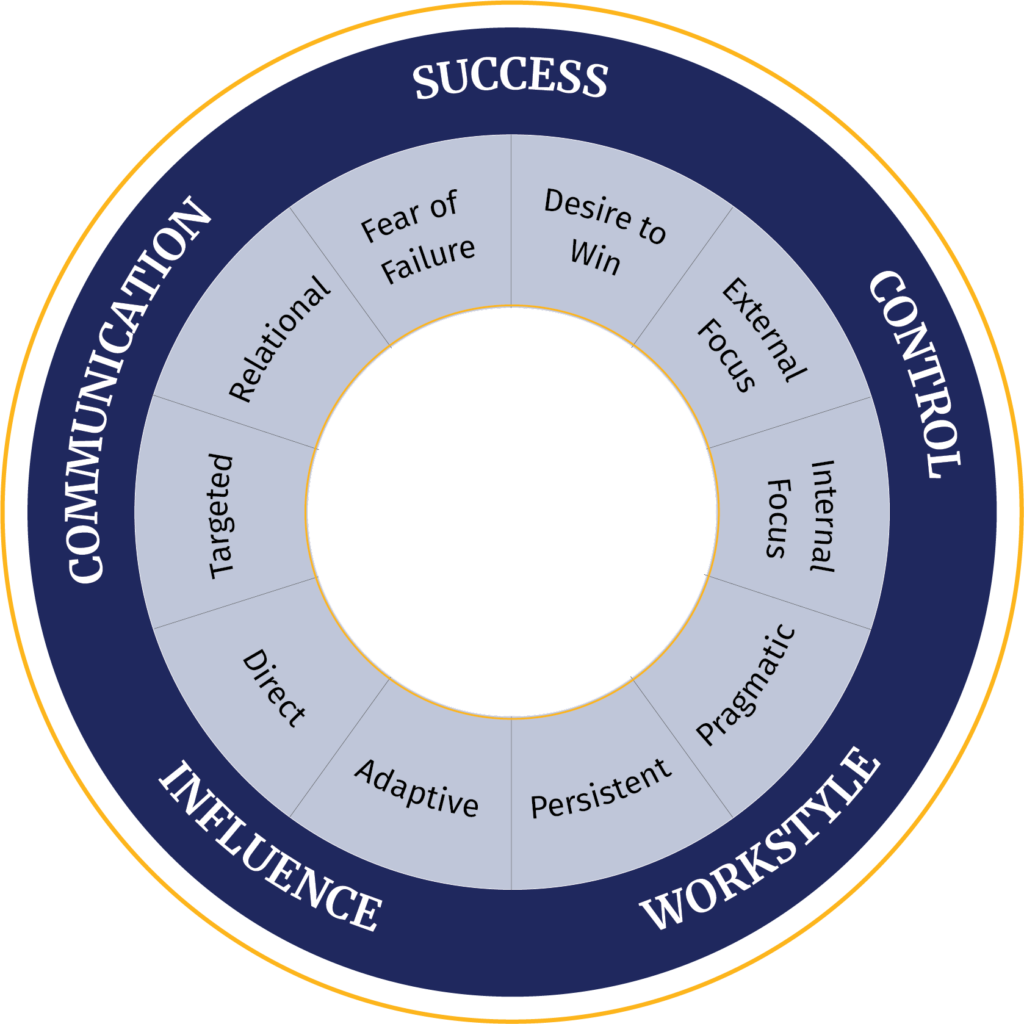
That research informed the development of the Commercial Impact Profiler (CIP), which looks beneath observable behaviour across five areas of commercial belief.
Rather than simply asking whether someone demonstrates a particular sales behaviour, it helps us understand what may be driving that behaviour in the first place.
The Commercial Impact Profiler (CIP) explores five areas of belief that shape commercial behaviour:
Success – what drives someone towards commercial outcomes.
Control – the extent to which they believe they can influence what happens.
Workstyle – how they approach persistence, progress and changing course.
Influence – how directly or adaptively they seek to influence others.
Communication – how they approach dialogue, relationships and the exchange of value.
This creates a deeper view of what may be shaping the behaviour we see and gives organisations a stronger basis for making data-driven decisions about commercial capability.
A different way to think about commercial capability
For organisations, that distinction matters well beyond the individual. At an individual level, it creates a more precise basis for development.
Across teams, it can reveal where collective strengths sit and where common barriers may be limiting performance.
Across larger populations, it can help organisations identify whether a commercial challenge is primarily about capability, leadership, talent or the wider environment in which people are expected to perform.
It can also add another perspective to conversations about commercial potential. Current performance tells us what somebody is delivering now; it does not always tell us where further commercial capability could be unlocked with the right development and environment.
So perhaps the most useful question is not simply: “How do we teach our people to sell?”
It is: “What is shaping how our people think and behave commercially, and what would help them create greater impact?”
That shift takes commercial development beyond asking people to “be more commercial” and towards understanding what needs to change.
Our white paper, From Expertise to Commercial Impact, explores the psychology shaping commercial effectiveness, what our research tells us about high commercial performers, and how organisations can use that insight to build commercial capability more deliberately.
For further details or to explore how we can support your organisation, please reach out to us at letushelp@peoplewise.co.uk