What makes coaching truly effective? Discover the psychology behind lasting behaviour change and high-performing leaders.

Coaching continues to rise in popularity—and with good reason. It’s widely recognised for its positive impact on performance, realising individual potential, and building effective relationships. Despite the growing interest and investment in coaching, we still have much to learn about how and why it works.
What are the psychological mechanisms that drive meaningful change? And what really makes one coaching intervention more successful than another?
Here at Peoplewise, we would argue that what makes our coaching powerful is the combination of our coaching and psychological training, and the research, and our clients agree.
“I have learned a lot about myself and the reasons for certain behaviours which were hindering progress, impact and confidence, and have acquired tools and techniques to use (and the confidence to use them!) to help me be more engaged, vulnerable and impactful. I feel more confident, more able to take risks in the face of uncertainty and have greater belief in the value I can and do bring.” C Suite Executive, Manufacturing
A meta-analysis by Wang et al. (2022) offers some important answers. Drawing on 20 research studies involving 957 participants, the study explored the effectiveness of psychology-informed coaching. The findings mark a significant step forward in understanding the inner workings of effective coaching.
The Power of Psychology in Coaching
What the research makes clear is that coaching grounded in psychological principles—particularly those focused on thoughts and behaviours—has a real and measurable impact. Participants showed marked improvements in goal attainment and self-confidence, particularly when performance was assessed by others (e.g. through 360° feedback), rather than self-reported.
Coaching which focuses on increasing self-awareness was identified as especially effective. Through deepening self-awareness, the individual takes ownership and builds a greater understanding of the impact of their behaviours on themselves, others and the business. Helping individuals to make informed choices and develop better self-management strategies, which contribute to lasting changes and greater job satisfaction.
Interestingly, no single, widely used coaching method outperformed the rest. Instead, the study found that integrative coaching—which blends techniques from different psychological frameworks—produced the strongest results. This approach not only improved performance but also enhanced psychological well-being.
Turning Insight into Impact
What does this mean for coaching in practice? To be truly effective, coaching should:
- Help people understand and manage their thoughts and behaviours (e.g. using cognitive-behavioural and solution-focused techniques),
- Leverage a broad toolkit of approaches—carefully chosen to align with the individual’s unique challenges, goals, and environment,
- Consider the broader context—such as organisational culture, role demands, and personal motivators.
This integrative, psychologically-informed approach is more likely to deliver meaningful, sustainable results—for both individuals and organisations.
The Peoplewise Approach: Aligned with the Evidence
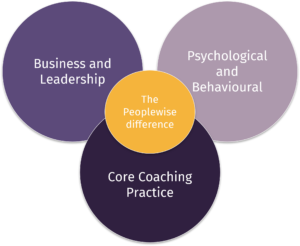
What’s exciting is how closely this research aligns with the Peoplewise coaching framework. At the heart of our approach is the belief that coaching must integrate psychological insight, real-world business acumen, and strong coaching practice. Our science-based model is designed to drive lasting impact.
-
Business and Leadership
Our coaching is firmly rooted in organisational culture, designed to reflect and reinforce the company’s core values, strategic goals, and overall mission. Our coaches bring deep experience of organisational dynamics, strategic challenges, and the leadership landscape—so that coaching supports both individual growth and business outcomes.
-
Psychological and Behavioural
We focus on mindset, emotional patterns, motivation, and behaviour change—enabling individuals to make meaningful, lasting shifts. By helping individuals recognise unhelpful thought patterns and build new, more constructive habits, we support deep transformation that goes beyond surface-level change. It’s about unlocking potential from the inside out—developing greater self-awareness, resilience, and the capacity to act with intention in complex environments.
-
Core Coaching Practice
Our psychologically trained coaches don’t rely on a single, off-the-shelf framework. Instead, they draw from a rich and diverse toolkit of evidence-based methods, models, and assessments—carefully selecting and adapting their approach to fit each individual and organisational context. This flexibility allows them to respond with precision, challenge constructively, and create the conditions for meaningful, sustainable change.
That’s the Peoplewise Difference
Where these three domains intersect is what we call The Peoplewise Difference. It’s where strategic business thinking, psychological rigour, and expert coaching come together to deliver transformational change. This is what makes our coaching human-centred, results-driven, and truly effective.
If you are considering a coach for yourself or an executive, choose a coach who understands the Psychology of change
- The research is clear: when investing in coaching, choose professionals who combine psychological insight, structured methods, and relational intelligence.
- The science shows that coaching isn’t just about helping people think — it’s about helping them make sustainable positive changes.
- Effective coaching is psychological coaching. The data supports it — and the workplace deserves it.
Curious about how Peoplewise delivers coaching that truly drives change? Reach out to us at letushelp@peoplewise.co.uk. —we’re here to talk.
___
Reference list
Wang, Q., Lai, Y.-L., Xu, X. and McDowall, A., 2022. The effectiveness of workplace coaching: a meta-analysis of contemporary psychologically informed coaching approaches. Journal of Work-Applied Management, 14(1), pp.77–101.
Peoplewise, 2024. Inside the ‘black box’ of coaching: An essential business guide to realising the strategic value of coaching within organisations. London: Peoplewise Ltd.